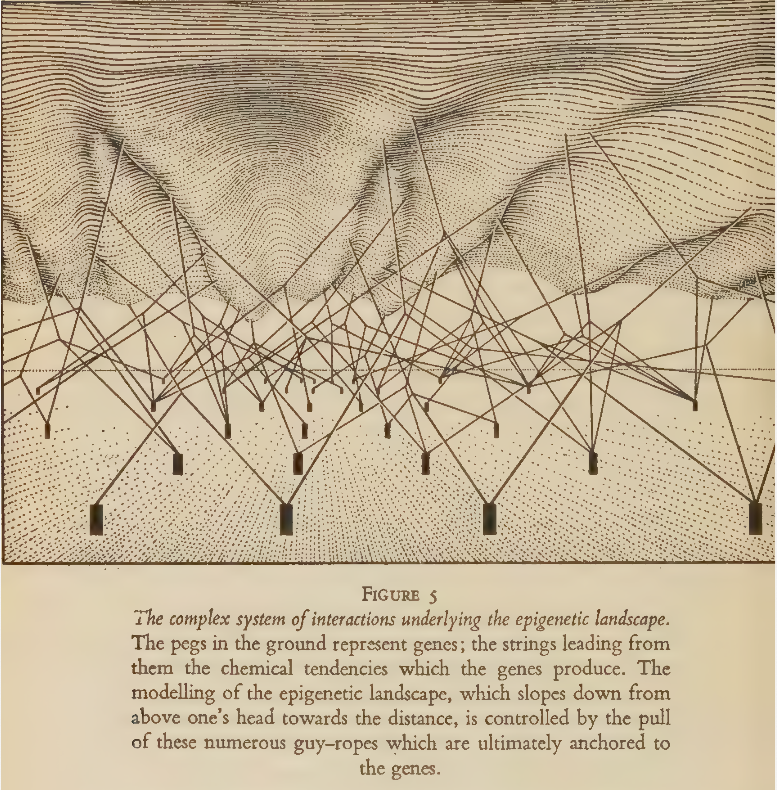
[Waddington] visualized the developmental process as a landscape with hills and valleys that split every so often like those in a river network. At the very top of the highest hill he imagined a ball, which represented a population of cells in their earliest embryonic form — what we now call stem or pluripotent cells, which have the potential to become any cell type. The progression of the cells towards their fates — to become, say, skin cells, muscle cells, or nerve cells — is like the ball rolling downhill through the landscape.
When the ball reaches a branching point (bifurcation), the model’s “gravity” pulls it to one track or the other: In scientific terms, it must differentiate. Through a particular sequence of such branching decisions, Waddington argued, cells specialize into their mature types, or fates, each expressing a particular set of genes. The cells are restricted to a small number of well-defined states because they are “canalized,” in Waddington’s lexicon: trapped and channeled by the sides of the valley. In this way, a limited number of cell types reliably arise from the activity of an army of genes.
How Does Life Unfold? A Landscape Metaphor Comes Into Its Own.
Tidigare om metaforer: Varia – juli 2026 / Kriget mot metaforerna.